
SOLD
India Trade Cotton
19th century
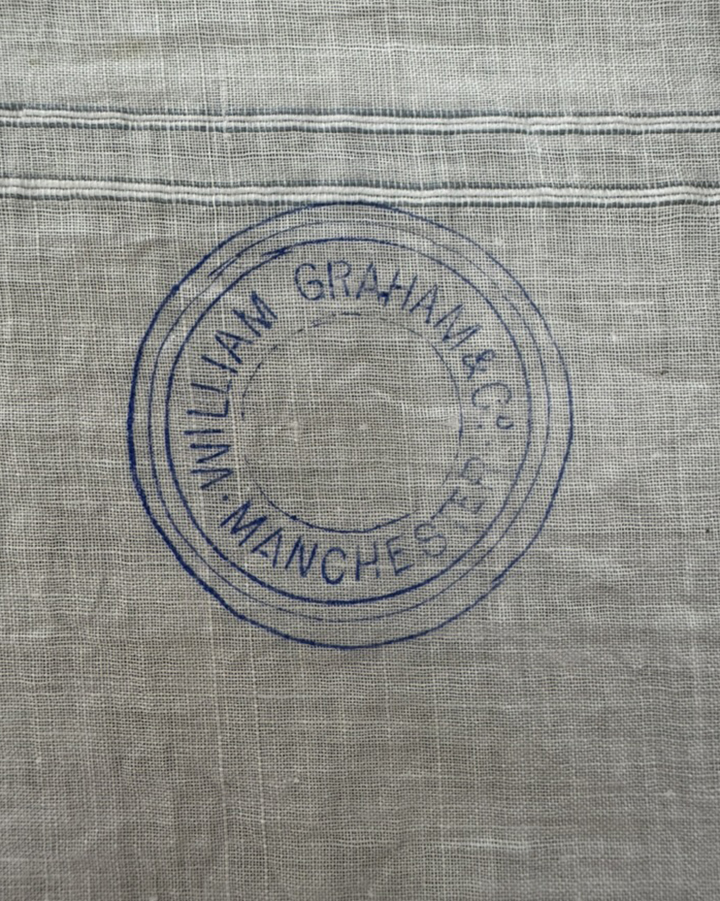
I think this may be a bale wrapping for cotton coming from India, proibably Bengal. A most interesting piece of Manchester history. William Graham & Co. was a major 19th-century Scottish merchant and shipping firm, later with a large Manchester presence. Heavily involved in the international cotton, textile, and wine trades the company were Manchester, Lancashire textile manufacturers and East India traders, importing Indian cottons. Graham's set up in Manchester about 1840 and was still going in the early 20th century at 86 Major Street, Manchester, Lancashire. The company was founded in 1784 in Glasgow, by William Graham Snr, the firm quickly expanded its mercantile operations to India, opening branches in Bombay, Calcutta, and Karachi. The Manchester office acted as the vital domestic hub for shipping these textiles and goods globally
According to J. Edward Graham in his book Short account of the Grahams of Tamrawer 1895, William (1762 -1836),
William established himself in business in Glasgow and established the firm of William Graham and Co in 1784. From this a large number of Graham’s companies, registered in Glasgow, were trading individually in Glasgow and elsewhere, including Portugal and India, as early as the late 18th century. In 1810 the business diversified and began importing wines from Portugal. Graham’s became one of Britain’s most prominent port shippers. Mr. Graham, who was twice married, died in 1836, leaving a large family; of his sons, four were associated with him in the business, and the eldest of these, Mr. William Graham (1817-1885), represented Glasgow in Parliament from 1865 till 1874 as a Liberal MP. At this time William Graham was a Scottish politician, wine merchant, cotton manufacturer and port shipper.*
The Lancefield Spinning Company was a prominent 19th-century cotton manufacturing firm in Glasgow, Scotland, founded by the Graham brothers. Established around 1840, the company operated a major cotton-spinning mill and weaving works near Lancefield Street and maintained business offices at 70 Miller Street. The factory was a massive industrial employer but also notorious for its vulnerability to fire. A major blaze in 1841 completely destroyed the mill, highlighting the era's severe fire safety limitations. The company was eventually dissolved in 1876.
Cataloguing
An end of a bolt of fine soft Indian cotton with five rows of blue cotton to the end and two rows of white and blue cotton further in, a blue printed stamp of William Graham & Co, Manchester, a further blue stamp 848 and 18 yds, an Indian gold filé thread embroidered leafy spray and 5950.
36 x 39 in; 90 x 1m
Condition
Very good.
Comments
* https://www.thesweetfamily.co.uk/scott/east-india-trade/